Currency: Japanese Yen (JPY) [01 JPY = 0.0082 USD]
Reasons to visit Japan
Antiquity and modernity vie for attention in Japan, whose monarchical and feudal history contrast sharply with its current pro-Western attitude and technological innovations. This juxtaposition, combined with a tradition-rich culture, complex and profound Buddhist and Shinto spiritual traditions and natural attractions, make Japan potentially appealing to travellers of varied interests.
Historic Landmarks:
Of Japan's castles, the most arresting, says Frommer's, is the 17th century Himeji Castle (himeji-castle.gr.jp), known for its white walls. Matsumoto Castle (city.matsumoto.nagano.jp) has Japan's oldest keep. On the island of Okinawa, visit Shuri Castle Park (oki-park.jp/shurijo-park), which harbors ruins from the Ryukyuan culture that inhabited the region from the 12th to the 17th century. In Hiroshima stands the Hiroshima Peace Memorial (pcf.city.hiroshima.jp), the only building that remained standing after the atomic bomb explosion in August 1945.
Religious Sites:
Religious sites are among Japan's top draws. Kyoto, the capital from the late-8th to the mid-19th century, has several famous Buddhist temples, including the Kiyomizu Temple (kiyomizudera.or.jp) and Sanjusangendo Hall (no website; 657, Kaimachi, Sanjusangendo, Higashiyama-ku, Kyoto-city, Kyoto; 075-561-0467). The latter is known for its 1,001 statues of the goddess Kannon. In Tokyo, the modern capital, there is the Sensoji Temple (senso-ji.jp), constructed in the 7th century to house a statue of the Kannon said to have been caught in the Sumida River. Japan's most lavish Shinto shrine is the 17th-century Toshogu Shrine (nikko-jp.org) in Nikko, which is adorned with gold leaf.
Cultural Experiences:
One of Japan's signature experiences is lodging at a traditional inn, known as a ryokan, where rooms feature sliding paper walls, straw mats and Japanese versions of futons. Frommer's recommends the Hiiragiya Ryokan (hiiragiya.co.jp) in Kyoto, established in 1861, and the Iwaso Ryokan (iwaso.com) in Miyajima. Another quintessential Japanese tradition is the tea ceremony, a highly structured ritual that dates to the 16th century, which you can experience in tea houses throughout Japan. In Tokyo, sports aficionados will want to take in a sumo wrestling match at the Kokugikan arena (sumo.or.jp). Sumo, Japan's national sport, is a 1,500-year-old practice.
Cuisine:
Avid eaters can indulge their palates in Japan, where the most luxurious dining experience is the kaiseki meal that consists of a series of dishes. The ingredients and presentations depend on the season. Also traditional, but far less fancy, are bento boxes, a lunch option that includes a combination of rice, pickles, fish or meat and vegetables. Daring foodies will want to try blowfish, known locally as fugu. Choose a government-licensed chef, since eating fugu that has been incorrectly prepared can be fatal.
Outdoor Activities:
Among Japan's top athletic pursuits is climbing Mount Fuji, situated 62 miles southwest of Tokyo. At 12,355 feet, it is the country's tallest mountain. As many as 400,000 people climb Mount Fuji every year during the climbing season, which runs from July through Aug. 31. In addition, the coral reefs off Okinawa make the island one of the world's best places for scuba diving. In the winter, the Japanese Alps and the mountains of Tohoku and Hokkaido draw many skiers.
| City | World Heritage Site | Description |
| Tokyo | Ogasawara Islands | The Ogasawara Islands is the general term for 30 islands of various size scattered over the Pacific Ocean. Located to the south of the Izu Islands, they are made up of three groups of islands. |
| Shirakami-sanchi | The vast primeval beech forest, which is home to a precious population of animals and plants, is just like a forest museum.
Directions: Shirakami-sanchi Visitor Center: 5-minute walk from Nishimeya Murayakuba-mae bus stop. The Nishimeya Murayakuba-mae bus stop is approx. 50 minutes by Konan bus (to Tashiro) from the Hirosaki Bus Terminal near the JR Hirosaki station.
From Tokyo to Hirosaki:
4h 50 min from Tokyo Station to Shin-Aomori Station by JR Tohoku Shinkansen Line. 40 min from Shin-Aomori to Hirosaki Station by JR Ou Line. |
| Mt. Fuji | The highest mountain in Japan, Mt. Fuji is 3,776 meters above sea level, and is located more or less in the center of Japan, stretching over Shizuoka and Yamanashi prefectures. The worship of Fujisan is unique in nature, centering on efforts to draw power from the deitiesresiding on the mountain and to experience of a symbolic death and rebirth in the course of making worship-ascents from the slopes to the summit of the mountain and pilgrimages to religious sites at the foot of the mountain. |
| Kyoto | Kamigamo Areaax | Kamigamo-jinja Shrine, the oldest shrine in Kyoto. Sha-ke, the residential quarters of the Shinto priests, rest on stone foundations. |
| Shimogamo-jinja Shrine | Shimogamo-jinja is one of the oldest shrines in Kyoto. Its history goes back to ancient times. |
| Daigo-ji Temple | Established in the 9th century, Daigo-ji was restored in the 16th century by the hegemon Toyotomi Hideyoshi, the supreme leader of Japan at that time. Properties contained here, the entire temple is recognized by UNESCO as a World Cultural Heritages. |
| Nijo Castle | Nijo Castle (Nijo-jo) was built in 1603 by Tokugawa Ieyasu, the founding shogun of the Edo shogunate which ruled Japan from the beginning of the 17th century, for use as a base when he was in Kyoto. The castle ground measures roughly 500 m. east to west and about 400 m north to south, and is designated a Historic Site. |
| Jisho-ji Temple (Ginkaku-ji Temple) | A historical Zen temple featuring a silver pavilion and an expansive, well-known garden. An impressive assembly of traditional Japanese landscaping and architecture that is a must see during your stay in Kyoto. |
| Kiyomizu-dera Temple | Kiyomizu-dera is one of the most famous temples in Kyoto and was built at the end of the 8th century. The main hall was constructed in the 17th century, and is famous for its location overhanging a cliff. |
| Nara | Nara prefecture, Horyu-ji Area | Horyu-ji Temple was the first Japanese world heritage site registered back in 1993. Hoki-ji Temple is also registered as a world heritage site. |
| Himeji | Hyogo prefecture; Himeji-jo Castle | Because its pure white appearance with white plaster coating looks like a dancing Shirasagi (Egret) with wings spread, this famous castle is also called the "Shirasagi-jo" or "Hakuro-jo". It was spared from damage during the war and from many other disasters and is in a remarkably preserved state compared to other castles. Seventy-four structures within the castle site including a tower and gate are designated as important cultural assets of Japan. |
| Yakushima | Yakushima Island | Enjoy the unspoiled richness of nature on a mysterious island where time stands still. Yakushima is a round-shaped island situated approx. 60 km south from the southern end of Osumi Peninsula in the southern part of Kagoshima prefecture. One fifth of the island is registered as a natural heritage site. There are as many as 6 mountain peaks over 1,800 m high including Miyanoura-dake (1,935 m above sea level), the highest mountain in Kyushu, and this is what gives the island its other name-the 'Alps on the ocean'. |
| Hiroshima | Hiroshima Peace Memorial (Genbaku Dome) | The Genbaku Dome is the ruin of the former Hiroshima Prefectural Industrial Promotion Hall that was destroyed when the first nuclear weapon/atomic bomb in human history was dropped by an American air force bomber on August 6, 1945. Because the atomic blast was almost directly above this spot, the walls of the building were partially spared from destruction, and the characteristic form of the building remained with the iron frame of the dome. This building representing Hiroshima, the first city to fall victim to nuclear bombing is registered as a world heritage site as a symbol of prayer for permanent world peace and the elimination of all nuclear weapons. |
| Ohda | Iwami Ginzan Silver Mine, Oda-shi, Shimane Prefecture | Iwami Ginzan was one of the world's leading mines producing high-quality silver from 1526 to 1923. This mine is located over a wide area in the central region of Shimane Prefecture of the Chugoku Region. The silver excavated from this mine was exported to Europe via East Asia, and played a vital role in the East-West trade. It is said that approximately one third of the silver that was in circulation worldwide in the 16th Century was produced in this mine in Iwami. The great significance of the ancient remains of Iwami Ginzan Silver Mine lies in the fact that abundant traces of silver production from the mining sites to transportation routes have survived almost intact to this day. |
| Nikko | Tochigi prefecture, The Shrines and Temples of Nikko | The "Shrines and Temples of Nikko" refer to the Toshogu and Futarasan-jinja shrines and the Rinnoji temple as well as their surroundings.
Toshogu is where Ieyasu Tokugawa (ruling from 1603 to 1605) is enshrined; he was the first shogun of the Edo Shogunate, which flourished between the 17th and 19th centuries. As many as 127,000 craftsmen were involved in constructing the shrine, using the highest level of technology available at the time. The two-story "Yomei-mon Gate", decorated with brilliant colors and over 500 sculptures, is particularly famous. It is also called "Higurashi-mon (sunset gate)", because people spend all day long gazing at its beauty. |
Season:
Low Season (Jan–Mar): Winter is cool or cold in most of Honshū, but it's fine for travel. Be ready for snow in the mountains. Many businesses close over the New Year period (end December and early January)
Shoulder (Jun & Jul, Sep–Dec): June and July is rainy season in most of Japan (except Hokkaidō) – it doesn't rain every day but it can be pretty humid. Autumn (September to mid-December) is usually cool and clear.
High Season (Apr & May, Aug): Flights are pricey around the Golden Week (early May), O-Bon (mid-August) and New Year. Honshū cities are busy in the cherry blossom (late March to early April) and autumn foliage (November) seasons.
Family, Culture, History:
Japan is a modern and interesting country with a robust heritage. Its cities may look westernized but beyond first impressions, there's very little about this Asian nation that could lull you into thinking you're in the West. Yet Japan also differs greatly from its Asian neighbours. Japan provides a very large range of attractions, from historical and cultural treasures to modern and futuristic sights and wonderful forests, mountains and sea coasts.
The city of Tokyo, the Japanese capital, is a magnetic mix of urban civilization and traditional culture. Tokyo is a very large city, the metropolis of Tokyo is composed of 23 city wards(ku), 26 cities, 5 towns and 8 villages, including the Izu and Ogasawara Islands, many small Pacific Islands located in the south of Japan's main island Honshu. The city possesses many amazing places, monuments, galleries, museums, parks and several other things to discovery in Tokyo. You will leave refreshed and recharged after of your visit to Tokyo.
Hakone is a resort region in the Kanagawa prefecture in the central region of Honshu in Japan. Hakone is famous for its views of mountains, scenic lakes, hot springs (onsen) and ryokans.
Kyoto is the second historical capital city of Japan. The ancient western and northern parts of the city present unique chances to perceive Japanese cultural heritage. Beyond the nondescript high-rises around Kyoto Station hides the Japan of your imagination: a place where you'll see geisha glide past 17th-century teahouses in Gion's narrow alleys; where you can imagine the lives of court nobility at the Imperial Palace; where you can seek contemplation in Ryoanji's Zen rock gardens and under billowing cherry trees on the Philosopher's Path.
Useful Tickets in Tokyo:
1) Tokyo Furii Kippu (Ticket)
One-day pass for JR, Toei streetcars, Toei buses, Toei subways and Tokyo Metro.
FARE: ¥1,580 (Child: ¥790)
- You can take JR trains (except JR express trains), Toei subways, Toei streetcars, Toei buses and Tokyo Metro as many times as you want.
- Available at JR stations, JR travel agency "View Plaza," Toei subway stations, sales offices of Toei buses and streetcars and ticket counters at major Tokyo Metro stations.
2) Tokunai Pass
JR one-day pass in Tokyo
FARE: ¥730 (Child: ¥360)
- You can take JR trains (except JR express trains) running within the 23 wards of Tokyo as many times as you want.
-Available at JR stations and JR travel agency "View Plaza."
3) Toei One-Day Economy Pass
(Ichinichi Josha-ken)
One-day pass for Toei subways, buses and streetcars.
FARE: ¥700 (Child: ¥350)
-For day-of-use purchase, available on Toei streetcars, buses and from ticket vending machines at Toei Subway stations.
-For advance purchase, available at Toei subway pass vending locations, station counters, Toei Streetcar/Bus offices and pass vending locations.(Must be used within six months of purchase date.)
4) Tokyo Metro One-Day Open Ticket
(Ichinichi Josha-ken)
One-day pass for all Tokyo Metro.
FARE: ¥710 (Child: ¥360)
-For day-of-use purchase, available from ticket vending machines at Tokyo Metro stations.
-For advance purchase, available from ticket counters at major Tokyo Metro stations.
5) Toei and Tokyo Metro One-Day Pass
(Kyotsu Ichinichi Josha-ken)
One-day pass for both Toei and Tokyo Metro
FARE: ¥1,000 (Child: ¥500)
-Available at ticket vending machines at Toei and Tokyo Metro stations.
-No advance purchase.
6) Yurikamome One-Day Open Ticket
(Ichinichi Josha-ken)
Useful one-day pass for Odaiba (Tokyo Bay) area.
Fare:¥800 (Child: ¥400)
-Available at ticket vending machines at all Yurikamome stations.
Smartcards or IC Cards
Suica & PASMO
They are convenient for use on most railway system, subways and buses in Greater Tokyo. Just touch the card on the scanner at the entrance gates, and again as you leave at your destination. The fare will be automatically deducted.
*Note: ¥210 handling fee will apply when you return an unused Suica. So using up all the charged fare before returning a Suica card is recommended. The ¥500 deposit will be refunded.
1) Suica issued by JR East
PRICE: ¥2,000 including returnable deposit of ¥500 which will be refunded when the card is returned for reimbursement purpose at the JR EAST tickets offices. (Please see *Note above)
-Available at card vending machines and JR EAST ticket offices (Midori-no-madoguchi).
-Can be recharged by cash payments at automatic ticket vending machines and fare adjustment machines at any JR stations.
-Can be used as electronic money in shops with Suica mark such as convenience stores, kiosks, restaurants and fast-food outlets.
2) PASMO issued by other companies
PRICE: ¥1.000, ¥2.000, ¥3.000, ¥4.000, ¥5.000 or ¥10.000 including returnable deposit of ¥500 which will be refunded when the card is returned for reimbursement purposes at the office that handles PASMO. (Please see *Note above)
-Available at card vending machines and the ticket offices that handle PASMO.
-Can be recharged by cash payments at automatic ticket vending machines and fare adjustment machines at the stations.
-PASMO can be used as electronic money at member stores.
Unique Facts:
100 Yen Shop Information: A wide range of items - from foods to articles for daily use - are all sold at a uniform price of 100 yen.
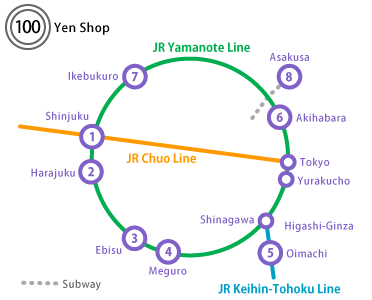
Nearest Sta./
Shop's Name | Business Hour | Phone (in Japanese) | Location |
| 1) JR Shinjuku Sta. |
| Silk Sampei More Chuo-dori | 10:00-23:00 | 03-3358-4360 | Near Studio ALTA
3 min. walk from JR Shinjuku Sta. (East Exit) |
| 2) JR Harajuku Sta. |
| The Daiso Harajuku | 10:00-21:00 | 03-5775-9641 | 1 min. walk from JR Harajuku Sta.
(Takeshita-guchi Exit) |
| 3) JR Ebisu Sta. |
| Can Do Ebisu | 10:00-23:00 | 03-3793-6161 | 2F, Matsuzakaya Store
JR Ebisu Sta. (West Exit) |
| 4) JR Meguro Sta. |
| Can Do Meguro | 10:00-22:00 | 03-3493-3487 | 2F, Tokyu Store
JR Meguro Sta.(West Exit) |
| 5) JR Oimachi Sta. |
| Can Do Oimachi | 10:00-20:00 | 03-5746-1157 | 2F, Hankyu Store
JR Oimachi Sta. (West Exit) |
| The Daiso Oimachi | 10:30-20:00 | 03-5783-2103 | 7F & 8F, Marui Dept. Store
JR Oimachi Sta. (East Exit) |
| 6) JR Akihabara Sta. |
| The Daiso Takarada Akihabara | 11:00-20:30 | 03-3253-0101 | B1, Takaradamusen
JR Akihabara Sta. (West Exit) |
| Can Do Akiba Chuo-dori | 10:00-21:00 | 03-3253-3575 | 5 min. walk from JR Akihabara Sta. |
| 7) JR Shinjuku Sta. |
| Can Do Ikebukuro | 10:00-22:00 | 03-5952-5355 | 1st & 2nd Fl., FLC Bldg.
5 min. walk from Ikebukuro Sta. (East Exit) |
| 8) Subway Asakusa Sta. |
| The Diso Asakusa ROX | 10:30-21:00 | 03-5827-1905 | 2nd Fl., ROX Bldg.,
10 min. walk from Subway Asakusa Sta. (Exit 1) |
An 8% consumption tax will be levied. All information is based on data as of March 2013 and is subject to change without notice.
MUSAFIR PRODUCTS
| Just Japan | With Flight | Nights | Musafir Special Offer |
| Divine Japan | Yes | 5N | - |