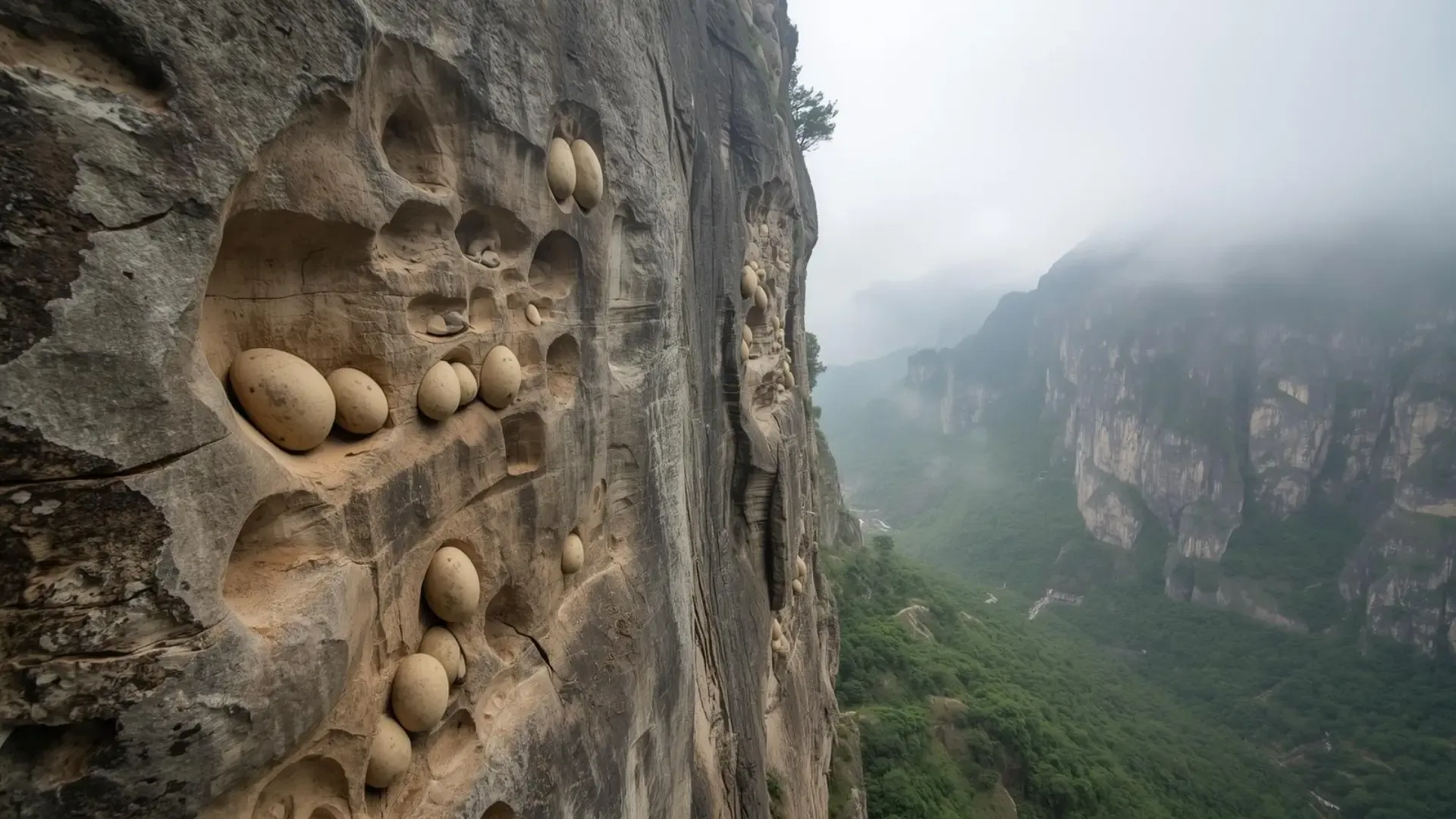
If I told you there is a mountain that lays eggs, that too in China, wouldn’t you just laugh and think I am joking. I mean it’s China, anything is possible!
Tucked away in China’s Guizhou Province, there is a cliff that locals call ‘Chan Da Ya’, which means “the cliff that lays eggs,” and the name is not an exaggeration. Every few decades, the mountain releases smooth, round, stone “eggs” that detach from its surface and tumble to the ground below.
You read that right, stones. Real, heavy, spherical rocks.
It has been noticed that every 30 years or so since centuries, these mysterious egg shaped stones roll off the cliff. These stones can be as small as your fist or as big as a watermelon. They all may sound mythical to you, but it’s entirely true, the magic doesn’t end even once science steps in to explain about it.
But before we go ahead, if you are planning to visit Chan Da Ya Cliff China we can help you book the best hotels in Guangzhou.
A Quiet Mountain that Became a Global Curiosity
![1[1] (4).webp](/_next/image?url=https%3A%2F%2Fassets.musafir.com%2Fin%2F1_1_4_c2db1d2265.webp&w=2048&q=75)
The first written mentions of Chan Da Ya go back generations, long before geology was a science. To villagers, the mountain was alive, growing rocks like fruit and dropping them when they were “ripe.” Families who managed to retrieve the stones believed they brought good luck and protection. Some called them dragon eggs, others earth eggs, and others simply prized them as rare gifts from nature.
It wasn’t until the late 20th century that Chan Da Ya China broke into international awareness. Photos of perfectly smooth stone spheres began circulating, triggering equal amounts of skepticism and amazement. “How could a cliff produce stone balls so round?” scientists wondered. Soon researchers came in to figure out the phenomenon firsthand but they weren’t the only ones. With a hope of seeing a stone roll off the cliff, tourists from all over visit this place. Even though it happens once in maybe decades, just the thought of it is enough to drag people here.
The Heart of the Mystery, How Does the Mountain Lay Eggs?
The stone eggs does have a geological origin rather than the supernatural one the locals believe. However, the story's wonder is not faded down by the scientific explanation, if fact it makes it more extraordinary.
Chan Da Ya is primarily composed of limestone. Millions of years ago, the cliff formed under water, and in that submerged world, mineral deposits primarily dolomite built up into small nodules inside the soft limestone. Compared to the surrounding rock, these mineral nodules were harder.
Over time, like with most mountains, geological forces lifted the seabed. As the ocean disappeared and the cliff was exposed to the air, something remarkable happened.
The softer limestone began to erode. The harder, spherical dolomite nodules resisted erosion And with each passing decade, the limestone wore away little by little. Eventually, the tough mineral balls popped out like eggs emerging from a nest of stone. This process, known as differential erosion, explains why the rocks are so smooth they were sculpted naturally over millions of years underwater before ever seeing the light of day. Each stone egg that falls from the cliff has been forming patiently for ages.
So yes Chan Da Ya doesn’t “lay eggs” exactly. It reveals them.
But it is easy now to understand why the villagers named the cliff so.
The Cultural Magic
![2[1] (4).webp](/_next/image?url=https%3A%2F%2Fassets.musafir.com%2Fin%2F2_1_4_dea4beedda.webp&w=2048&q=75)
While scientists may admire Chan Da Ya China for its geological uniqueness, the cultural romance around the stone eggs is equally fascinating.
Locals believe:
- The stones bring prosperity if kept at home
- Families who own them will have fertile land and healthy children
- They are powerful good-luck charms when placed near doorways
Villagers wash them, polish them, and sometimes carve stands for them as if displaying treasured antiques. It’s not uncommon for people to travel miles to buy or trade the stones during festivals. Tradition and personal belief are woven into the very fabric of this mountain.
And even today, when tourists arrive with smartphones and scientists bring tools and satellite data, the villagers still call the stones “sheng dan” living eggs.
There’s something grounding about that science helps us understand how something happens, but stories help us understand what it means.
The Tourism That Time Releases Slowly
Because the stones fall about once every 30 years, witnessing the event is almost mythical. Many visitors settle for simply seeing the stones already on the ground or spotting unfallen ones still embedded in the cliff.
It’s not just the cliff that is wonderful, but the surrounding as well is beautiful and magical. The rural roads and small villages living in a timeline of their own.
Many travelers who come to witness this geological wonder often plan their trip from Guangzhou, staying in some of the best hotels in Guangzhou before heading out on a scenic journey to Guizhou Province.
There is something humbling about that. The mountain doesn’t care about ticket sales, economic cycles, or social media algorithms. It is patient. It is ancient. It drops rocks only when it’s good and ready.
Why Places Like Chan Da Ya Matter

It’s easy to scroll past photos of natural wonders and think, “Cool,” and forget them just as quickly. But Chan Da Ya China lingers in the imagination. Maybe it’s the mystery, or maybe it’s the fact that you think mountains aren’t supposed to lay eggs, yet this one does.
Most of us live lives where our day is predictable, scheduled, optimised, and controlled but nature doesn't work that way. Chan Da Ya reminds us that the Earth doesn’t follow our timelines. Geology works on scales beyond what we as humans can comprehend, thousands of years, And yet, we are lucky enough to catch a glimpse of that slow magic with our own eyes.
Whether you’re staying in one of the best hotels in Guangzhou or in a humble village guesthouse near the cliff, the real luxury is standing in front of nature’s mystery and letting yourself wonder.
More on China:
Take advantage of our exciting China tour packages and China Visa online services!